Spec sheets love big numbers, and the tow rating is usually the biggest one on the page. But moving a skid steer or a mini excavator to a job site depends on more than one figure. Real capability comes from the weakest link in a chain of ratings, and if you pick a truck on horsepower alone, that chain can snap in ways that cost you a trailer, a load, or worse.
- Tow rating and payload are separate limits, and construction gear tests both at once
- Tongue or pin weight, bed load, and passengers all count against the same numbers
- The lowest-rated part, whether it’s an axle or a hitch, sets your true ceiling
Two Numbers That Do Different Jobs
Towing capacity tells you how much weight the truck can pull behind it. Payload tells you how much weight the truck can carry, including people, tools, and the downward force the trailer puts on the hitch. These two limits live on different systems. A one-ton pickup might advertise a huge trailer figure while running out of payload long before you reach it.
That payload limit comes from the Gross Vehicle Weight Rating, or GVWR, which is the maximum loaded weight of the truck itself. Subtract what the truck weighs empty and you get your usable payload. The catch is that a loaded gooseneck or fifth-wheel trailer pushes a big share of its weight straight down onto the truck, so the trailer and the payload are fighting over the same budget.
Tongue Weight and Pin Weight Add Up Fast
When you tow, part of the trailer’s load rests on the coupling. On a bumper-pull trailer that share usually runs around 10 to 15 percent of the loaded trailer weight. Gooseneck and fifth-wheel setups sit higher, often 15 to 25 percent, because the connection sits over the rear axle inside the bed.
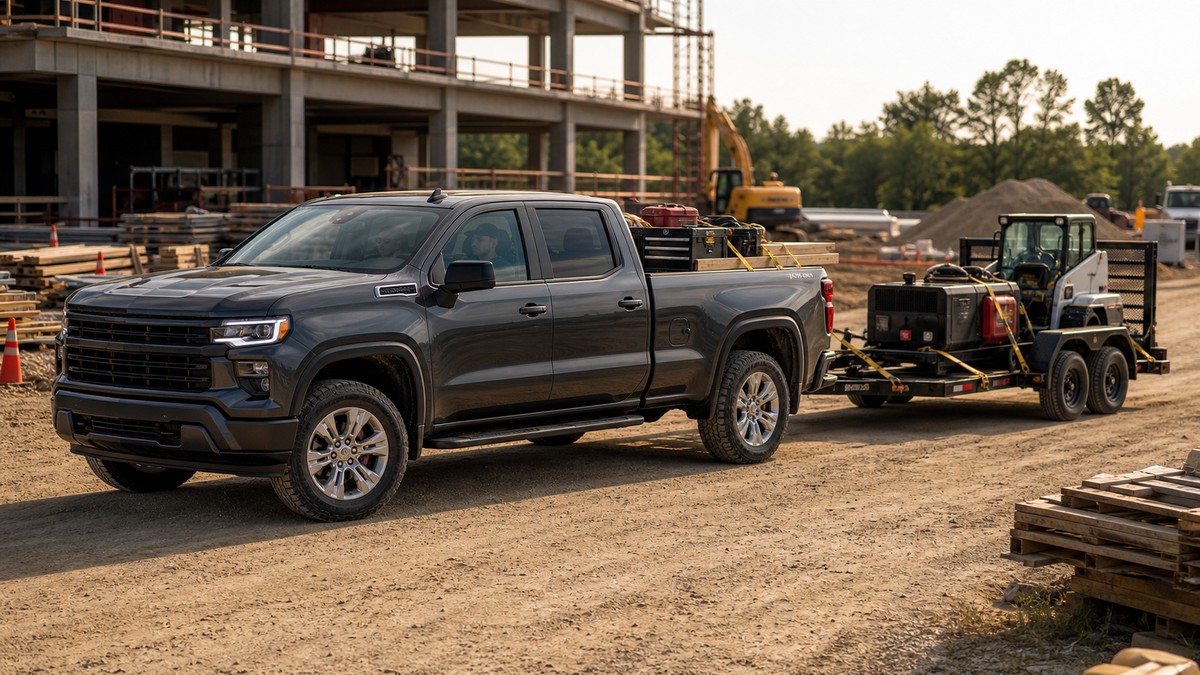
Say you’re hauling a compact track loader on a dual-axle trailer and the whole rig weighs 14,000 pounds. At 12 percent, the tongue is pressing about 1,680 pounds onto the truck. Add two workers, a toolbox, and some chains in the bed, and you can blow past payload while the trailer number still looks fine. This is why weighing your actual loaded setup beats trusting the brochure.
Axles and Hitches Set Hard Ceilings
Every truck also carries Gross Axle Weight Ratings, one for the front axle and one for the rear. The GAWR limits how much weight each axle can support, and a heavy tongue load lands mostly on the rear. You can be under GVWR overall and still overload the rear axle, which chews through tires and brakes and hurts steering.
The hitch hardware has its own limits too. Trailer hitches are grouped into classes, running from Class I for light duty up to Class V for the heaviest work. Each class carries a maximum trailer weight and a maximum tongue weight, and the receiver is only as strong as its lowest-rated part. Bolt a big ball mount onto an undersized receiver and the sticker on the mount means nothing. For construction loads you’re almost always in Class IV or V territory, or on a gooseneck or fifth-wheel mount rated for the job.
Why the Standard Behind Tow Ratings Matters
SAE J2807 is the reason modern tow ratings are worth comparing across brands. First released in 2008 and updated since, it sets a common test procedure so a Ford number and a Ram number mean roughly the same thing. The testing is brutal on purpose. One part sends a fully loaded rig up the Davis Dam grade on Arizona Route 68, climbing 3,500 feet over 11 miles in 100-degree heat with the air conditioning running. Others measure acceleration, stopping distance, and how the trailer sways at 62 mph. A truck earns its rating only by passing all of it.
Build the Rig From the Load Backward
Start with the equipment, not the truck. Weigh your heaviest machine, add the trailer, add fuel and attachments, then figure the tongue or pin weight and the bed load on top of that. Match those totals against GVWR, both axle ratings, the hitch class, and the tow rating, and let the smallest number decide. Do that math before you shop and you’ll walk onto the lot knowing which truck actually fits the work, instead of hoping a big headline figure covers you.
This post may contain affiliate links. Meaning a commission is given should you decide to make a purchase through these links, at no cost to you. All products shown are researched and tested to give an accurate review for you.